
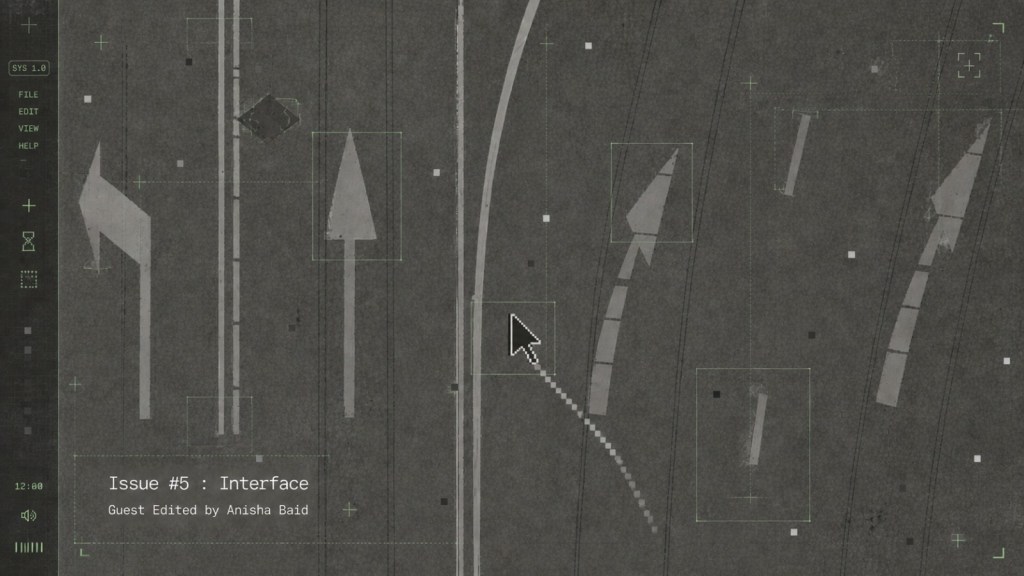
Guest Edited by Anisha Baid
“Interfaces carry – in every sense of the word – the global computerization of living conditions.” – Jan Distelmeyer
Branden Hookway points out that the term interface finds its origin in nineteenth-century fluid dynamics, where it was used to describe “the shared boundary where two different types of fluids or a fluid and a solid meet.” The word also appears in garment making, where interfacing refers to “material sewn or fused to the unseen side of fabric to make it more rigid.” In both cases, the interface signifies a zone of encounter: a place where separate materials meet, generating new forms and properties through their joining.
In contemporary digital interfaces, this meeting point can help us think about the frames and gestures of mediation – the double tick, the emoji, the paywall, the government portal – and the messages they might carry as media. Alexander Galloway calls this the ”interface effect” – a condition where digital systems don’t just mediate reality but remake the very terms of its existence in the process. These virtual windows exert behavioural, emotional and often financial control over a public who use them in every aspect of contemporary life – from work, to leisure to political representation.
Interfaces today claim to be ‘intuitive’ – assuming that there exists a common ground for intuition across geographic, cultural and social differences. This kind of design actively works to hide the labour it takes to understand, negotiate with and benefit from existing capitalist structures. Yet these contentious systems also contain the possibility of failure – glitches, modifications, and translations emerge. Vilem Flusser, in his essay “Why Do Typewriters Go ‘Click’” investigates its titular question through a philosophical musing on the nature of human-machine interactions. “Why do machines stutter?”, he asks, and goes on to answer himself – “Because everything there is in the world (and the whole world itself) stutters.” It is within these cracks that other cultures of use and meaning emerge.
Thinking of the interface in this way – less as a transparent medium and more as a field of cultural intervention – offers a framework for this issue. We invite a myriad of reflections on this camouflaged world of the interface – from doomscrolling, gig work, user personas, to interface design, dark patterns and more.
— Anisha Baid

by Nayantara Ranganathan

by Bobbie Fan

by Anisha Baid

by Tara Kelton

by Chinar Shah & Ajit Bhadoriya

by Pramodha Weerasekera
This issue of Purée Mag was made possible through the support of the Generator Cooperative Art Production Fund, 2025-26.